Decentralized Exhibition at Three Locations in Berlin-Mitte
Decentralised exhibition at various locations in Berlin-Mitte
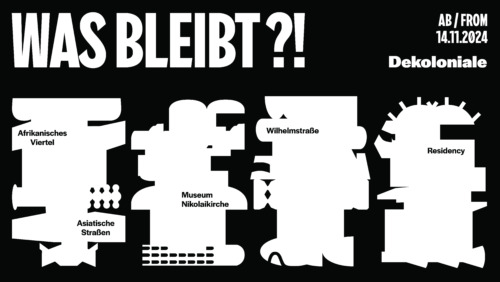
On November 14, 2024, the model project Dekoloniale Memory Culture in the City and the Stadtmuseum Berlin will open their decentralized exhibition “Dekoloniale – what remains?!” It explores Berlin’s centuries-long entanglement in the global history of slavery and colonialism and critically examines this violent past.
The exhibition features three significant sites of coloniality in Berlin-Mitte: the Museum Nikolaikirche, housing the tombs of colonial figures, the (post)colonial memorial that is the "Afrikanisches Viertel" ["African Quarter"] and the "Asiatisch-Pazifische Straßen" ["Asian-Pacific Streets"] in Berlin-Wedding, and the historical venue of the 1884/85 Berlin Conference on Wilhelmstraße 92. The exhibition goes beyond merely exposing the colonial racism embedded in these public spaces by overwriting it with the stories of resistance from African, Asian, and diasporic communities.
“Dekoloniale – what remains?!” concludes the inaugural phase of Dekoloniale Memory Culture in the City. It poses the question: What does it mean to maintain a lasting, consistent memory?
Museum Nikolaikirche
The Museum Nikolaikirche hosts two exhibitions: “Colonial Ghosts – Resistant Spirits. Church, Colonialism, and Beyond” and “Inscribed. Colonialism, Museum, and Resistance”.
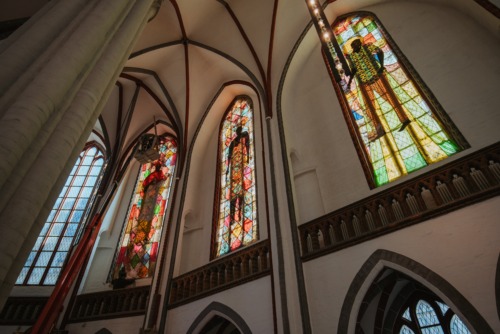
The group exhibition “Colonial Ghosts - Resistant Spirits. Church, Colonialism, and Beyond” features the Dekoloniale Berlin Residents 2024 Tonderai Koschke, Charlotte Ming, Percy Nii Nortey, Yangkun Shi, and Theresa Weber. They are presenting site-specific artworks that explore the church’s entanglement with colonialism, religion, politics and the writing of Berlin’s history by its citizens. Their art uses and re-appropriates Christian iconography and aesthetics.
Please note: The residents also intervene at other venues of “Dekoloniale – what remains?!”: Theresa Weber and Percy Nii Nortey at the historic site of the Berlin Conference at Wilhelmstraße 92 and Tonderai Koschke at the Afrikanische Straße subway station on the U6 line.
The historical exhibition “Inscribed. Colonialism, Museum, and Resistance” at the Museum Nikolaikirche features eight short biographies. They tell the story of how colonialism and the slave trade are interwoven with the Nikolaikirche and the Stiftung Stadtmuseum Berlin. And they tell the story of those who resisted and who, so far, have not been recognized in Berlin. The exhibition asks who is granted a perpetual place in European museums and churches and who is not.
Wilhelmstraße 92 | 10117 Berlin
Window exhibition “Remembrance. Apology. Reparation.”
Wilhelmstraße 92 is where – 140 years ago – the Berlin Conference in 1884/85 took place in the Reich Chancellery. It was at this conference where the colonial powers negotiated the (further) division and exploitation of Africa and Germany established itself as a colonial power. Today, the historical site of the perpetrators is home to the office of Dekoloniale Memory Culture in the City.
The exhibition “Remembrance. Apology. Reparation.” is dedicated to the history of the conference and African resistance to the implementation of its resolutions. It tells of the long-standing commitment of civil society to a central anti-colonial place of learning and remembrance in Berlin and of the significance that colonialism still has today.
Wilhelmstraße 92 also features site-specific artworks by artists-in-residence Theresa Weber and Percy Nii Nortey.

„African Quarter“ & „Asian-Pacific Streets“
Photo exhibition and memorial steles: “Paths of Remembrance”
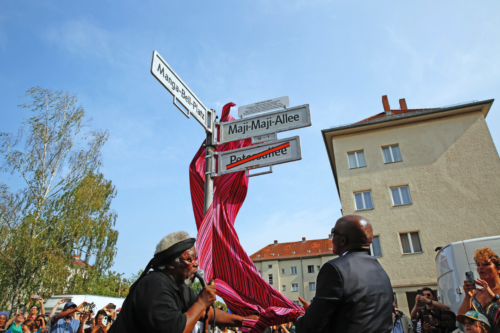
The inauguration of Maji-Maji-Allee and Anna-Mungunda-Allee in August 2024, marked the change of Germany’s largest colonial quarter, the Afrikanisches Viertel [African Quarter] in the Wedding district, to the first anti-colonial quarter. No other place in Germany is home to as many tributes to anti-colonial resistance fighters. We owe this transformation of the district to decades of activism by individuals and initiatives. These activists and initiatives are now being honored with a city-wide photo exhibition and at community centers .
Photo exhibition: Community Zentrum (CUZ) EOTO e.V. Address: Togostraße 76, 13351 Berlin Opening hours: Tuesday, Thursday | 2-6pm
Poster display: AfricAvenir International e.V.
Address: Kameruner Str. 1, 13351 Berlin
Additionally, there will be memorial steles installed in the Wedding district. At Cornelius-Fredericks-Straße, Manga-Bell-Platz, Anna-Mungunda-Allee, and Maji-Maji-Allee, the new namesakes of these streets will be made known.
At Pekinger Platz, Kiautschoustraße, and Samoastraße, reference is made to the colonial context of the street names and supplemented by anti-colonial counter-narratives.
The memorial steles bring African, Asian, and diasporic memories into a historical context by means of alternative forms of commemoration. The content and formats of the “Paths of Remembrance” exhibition were developed in a participatory process.
Dekoloniale resident Tonderai Koschke intervenes at the Afrikanische Straße subway station on the U6 line.